
Entomology World


Butterfly Garden & Insectarium
Established in partnership with the Bangkok Metropolitan Administration, its purpose is to educate the public on insect biodiversity, life cycles, ecological roles, and conservation — especially pollination, habitat relationships, and tropical ecosystem balance. Vsiitors stroll through enclosed butterfly gardens where multiple species flutter naturally among tropical plants, allowing close but non‑intrusive observation of life stages from caterpillar to chrysalis to adult. There are live insect displays (stick insects, beetles, grasshoppers) and interpretive panels that explain anatomy, behaviour, and ecological importance.
Insect Museum
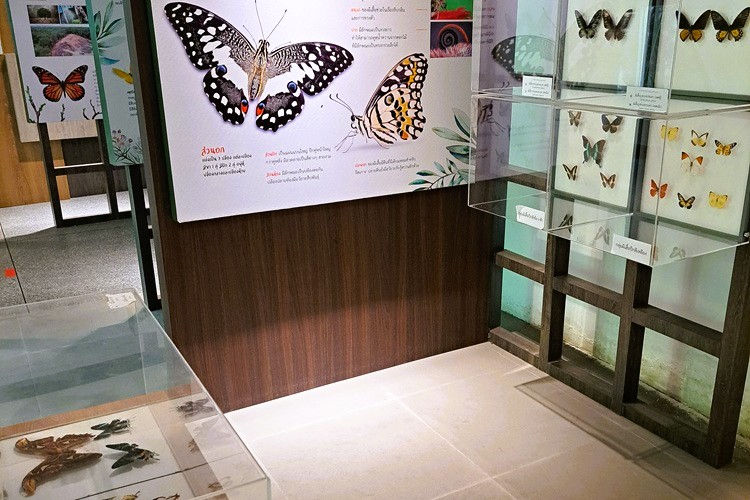
Founded to support research and teaching in entomology, pest management, and agricultural ecology, it emphasises the vast diversity of Thai insect fauna and their significance to ecosystems and food systems. Thai academic sources highlight its role in training students and professionals, while English references underline its research collection status and contribution to regional entomological knowledge. The museum features thousands of pinned insect specimens, arranged by order and family, including butterflies, beetles, beetle larvae, ants, grasshoppers, and medically significant insects such as mosquitoes. Detailed identification keys, microscopic views, and comparative displays help visitors understand morphological differences used in classification.
Ant Museum
Its purpose is to provide detailed insights into ant taxonomy, ecology, behaviour, and evolutionary significance, with particular emphasis on Southeast Asian species. Thai entomological literature often describes ants as ecological engineers, while English academic materials frame the collection as a research and education hub for ant biodiversity and behavioural studies. Displays include diverse ant species from across Thailand and the Indo‑Mekong region, showing size variation, caste systems (workers, soldiers, queens), and habitat adaptations. Microscopy stations and magnified exhibit cases help guests observe fine anatomical features, nest structure patterns, and inter‑species interaction behaviour.
Bee Learning Center
The centre is dedicated to the study and promotion of bees (including honeybees and native stingless bee species) with an emphasis on pollination science, sustainable beekeeping, and apiculture education. The centre supports research, hands‑on training, and community outreach on their importance in food security, ecosystem services, and biodiversity maintenance. Visitors encounter live hives in safe observation enclosures, witness pollination demonstrations, learn about hive management, and may be able to taste different regional honey varieties. Displays explain bee biology, communication (waggle dance), and the ecological importance of pollination.
Zoological Museum
The museum serves to preserve, document, and display specimens of Thailand’s vertebrate and invertebrate fauna, supporting biological research and biodiversity education. It functions as a key repository of reference specimens used for taxonomic, ecological, and conservation research. The museum displays skeletons, taxidermy mounts, preserved marine and terrestrial animals (from fish and reptiles to mammals and birds), and comparative anatomical exhibits. Information panels explain life histories, evolutionary relationships, and species distributions. Visitors can study adaptations such as flight in birds, camouflage in reptiles, and sensory systems in mammals.