
Prehistoric Period
Neolithic Age
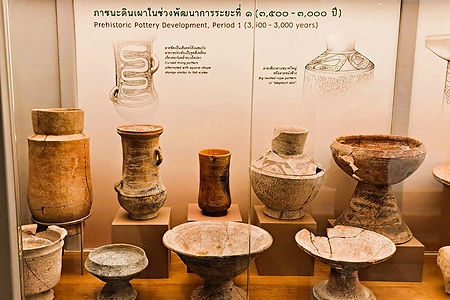
The Neolithic Age in what is now Thailand (about 3500 - 1500 BC depending on region) marks a decisive shift from mobile hunter-gatherer groups to settled farming communities. Archaeological evidence shows early villages located near rivers and fertile plains, where rice cultivation began to take root. This transition to agriculture brought more stable food supplies, population growth, and the emergence of social organization.
Material remains from this period are especially revealing. Polished stone tools such as adzes, axes, and grinding stones, indicate forest clearing and the processing of plant foods, reflecting a settled agrarian lifestyle. Pottery is one of the most significant Neolithic finds: vessels were often cord-marked or incised with simple geometric designs, suggesting both functional storage and early aesthetic expression. The presence of spindle whorls points to weaving and textile production, while stone ornaments and shell jewelry imply personal adornment and possibly emerging social distinctions.
Equally important are burial practices uncovered at these sites. Human remains are often found interred with grave goods such as pottery, tools, and ornaments, indicating early beliefs in an afterlife and ritual behavior. The variation in burial offerings suggests differences in status or roles within the community, hinting at the beginnings of social hierarchy. Together, these objects and practices reveal that Neolithic societies in Thailand were not only adapting to new economic realities but were also developing cultural, spiritual, and technological foundations that would shape later prehistoric civilizations in Southeast Asia.

Bronze Age
The Bronze Age in Thailand (approximately 1500 - 500 BC) represents a transformative period in prehistoric society, marked by the widespread adoption of metalworking and more complex settlements. During this era, communities began producing bronze tools, weapons, and ceremonial objects, signaling both technological innovation and growing social organization.
Artifacts from this period are remarkable in both variety and sophistication. Bronze implements, including axes, knives, spearheads, and fishhooks, indicate advanced metallurgical skills and improved efficiency in farming, hunting, and fishing. Pottery became more elaborate, often decorated with incised patterns or painted designs, suggesting both aesthetic sensibilities and symbolic meanings. Jewelry, such as bracelets, beads, and earrings crafted from bronze and semi-precious stones, points to the development of social differentiation and personal status within communities.
Burial practices during the Bronze Age also reflect significant cultural evolution. Many graves contain both utilitarian and decorative objects, implying beliefs in an afterlife and the social importance of the individual. The sophistication of grave goods, particularly bronze items, indicates that certain members of society held higher status, pointing to emerging hierarchies. Overall, the Bronze Age in Thailand illustrates a society in transition—one that combined technological innovation, artistic expression, and social complexity, setting the stage for the subsequent Iron Age and the early historic civilizations of Southeast Asia.
Iron Age
The Iron Age in Thailand (approximately 500 BC – 500 AD) represents a significant phase of social and technological advancement, building upon the foundations established during the Bronze Age. This period is characterized by the widespread use of iron for tools that contributed to population growth and settlements, which developed into more interconnected communities.
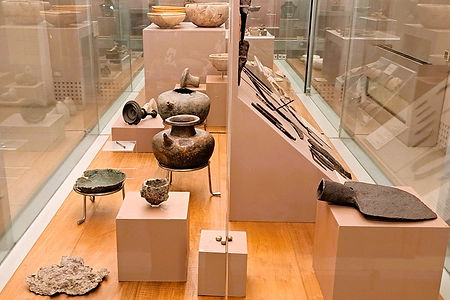
Artifacts from the Iron Age reveal notable progress in both craftsmanship and regional exchange. Iron implements such as ploughshares, blades, spearheads, and axes reflect improved production techniques and a deeper understanding of metallurgy. At the same time, bronze continued to be used for ornamental and ceremonial purposes, demonstrating continuity alongside innovation. Pottery styles became increasingly diverse, with refined forms and decorative elements that varied across regions, indicating the emergence of distinct cultural identities. Beads and ornaments made from glass, carnelian, and agate - often originating from distant regions - suggest the existance of long-distance trade networks as far as India and China.
Burial practices during the Iron Age further illustrate evolving social structures and beliefs. Graves frequently contain a wide range of goods, including iron tools, weapons, pottery, and personal ornaments, reflecting both daily life and ritual significance. The variation in the quantity and quality of grave goods points to clearer social stratification, with certain individuals accorded higher status. Some sites also show evidence of complex mortuary practices, including secondary burials and the use of large burial containers, indicating increasingly elaborate spiritual and ceremonial traditions. Overall, the Iron Age in Thailand marks a period of dynamic transformation that laid the groundwork for early states in Southeast Asia.