
Thonburi Conservation


Wang Derm Palace
Also known as Thonburi Palace, it was originally built in 1768 by King Taksin shortly after the fall of Ayutthaya. Over the ensuing century several members of the royal family resided there, until it was handed to the Royal Thai Navy in 1900. Its structures, including the original Throne Hall with traditional Thai roofs and unique open‑air layout, preserve architectural links to the late Ayutthaya era while housing exhibits on King Taksin’s reign and naval history.
Most prominently, the palace restoration project was awarded an Award of Merit from the UNESCO Asia‑Pacific Awards for Cultural Heritage Conservation, a prestigious regional program celebrating conservation excellence. The award citation specifically commended the project’s multifaceted and ambitious approach, highlighting how traditional building methods and craftsmanship were integrated and how important examples of royal decorative arts were preserved. This recognition underscores the palace’s significance not just as a historical site, but as a model for heritage conservation in Southeast Asia.
Wat Prayurawongsawat
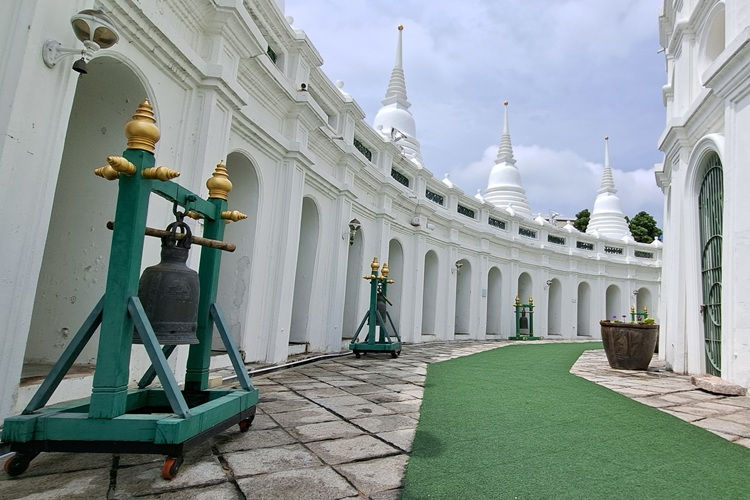
This 19th‑century Buddhist temple is a second‑class Royal Temple. The complex features the impressive Phra Borommathat Maha Chedi, a large bell‑shaped stupa in the Lanka style that houses Buddha relics and reflects architectural innovation of the early Rattanakosin era, as well as the Khao Mo rock garden representing Mount Meru and other noteworthy elements such as a three‑cannon monument and a museum preserving Buddha images and relics.
The temple’s conservation efforts have garnered the UNESCO Asia‑Pacific Awards for Cultural Heritage Conservation’s Award of Excellence. The exemplary restoration work is a testament to technical mastery and thoughtful integration of modern methods. Prior to this, the restoration project also earned accolades from the Association of Siamese Architects under Royal Patronage, and international groups for fostering community involvement in heritage preservation. The UNESCO award in particular underscored the project’s sensitive understanding of early Rattanakosin architectural typologies and highlighted the temple as a model for heritage conservation in the region.
Rabindhorn Building
The building began life as a school gymnasium, and was repurposed in 2019 by Arsomsilp Community and Environmental Architect into a dynamic architectural studio and community learning space. The project embodies a holistic educational ethos, bringing students, teachers and professional architects together “under one roof” to enrich architectural education through real‑world collaboration; the original wooden trusses and structural character were preserved to maintain a tangible link to its history, while sustainable strategies such as passive lighting and ventilation, use of recycled and local materials, and flexible studio spaces create an engaging environment that both honors its past and supports contemporary learning and community interaction. The design emphasizes adaptability, natural environmental integration, and fostering social and creative exchange within a revitalized communal architecture space.
The transformation of the Rabindhorn Building has earned significant architectural recognition for its innovative approach to adaptive reuse and community‑centric design. In 2024 it received the UNESCO Asia‑Pacific Award for Cultural Heritage Conservation under the category “New Design in Heritage Contexts,” commending its sensitive integration of modern design with the retention of historic structure and sustainable practices. The jury highlighted its restrained material palette, enhanced spatial qualities, and demonstration of sustainable building in an urban context. Additionally, it has been honored as a Jury’s Favorite in Architectural Design for Restoration and Renovation at the BLT Built Design Awards.