
Thai Buddist Temples

Temple Hierarchy
Buddhist temples are not only religious centers but also reflect a complex hierarchy recognized by the monarchy and the Sangha (monastic community). The title of a temple often indicates its historical significance, royal patronage, and religious status.
A Wat is the general term for any Buddhist temple and can range from a small local temple to a large monastery complex. Within a temple, the Viharn (assembly hall) is where the laity come to worship, make merit, and receive teachings from the monks. The Ubosot (ordination hall) is often part of this complex but a seperate building specifically reserved for monks.
When a temple receives royal recognition or elevated status, its title changes to reflect this distinction. A Woraviharn indicates a temple of higher merit or importance, often associated with the royal family or historically significant events. The prefix Ratcha - denotes direct royal patronage. Ratchaworaviharn and Ratchaworamahawihan signify temples with elevated prestige, where the latter - Mahawihan - marks it as a major national temple of great historical and religious significance. These titles often determine the temple’s eligibility for royal patronage and ceremonies.
Other specialized structures, such as Sala (pavilions) and Saman (resting halls), complement the temple complex, serving both practical and symbolic roles. Chedi or stupas are monumental, bell-shaped structures that often contain sacred relics, ashes of revered monks, or sacred Buddhist objects. They symbolize the Buddha’s enlightenment, the path to Nirvana, and the cosmological universe, serving as both devotional focal points and markers of spiritual merit. Together, the temple’s title and its constituent buildings illustrate the intricate interplay of faith, culture, and monarchy in Thai Buddhism, making each temple not only a sacred space but also a living record of the nation’s spiritual and historical legacy.

Exterior Architecture
Thai Buddhist temple architecture is instantly recognizable for its multi-tiered, steeply sloped roofs, gilded ornamentation, and intricate carvings, which combine aesthetic brilliance with spiritual symbolism. Features such as chofah finials, bai raka ridges, and sema stones are uniquely Thai, reflecting both the country’s Buddhist cosmology and its rich tradition of craftsmanship.
The main halls of a Thai Buddhist temple—the viharn (assembly hall) and the ubosot (ordination hall)—together define the temple’s exterior presence, each reflecting both functional design and sacred symbolism. Both are typically rectangular and raised on platforms, with steep, multi-tiered roofs that create a sense of verticality and grandeur. While the viharn is generally larger and more open to welcome worshippers, the ubosot is smaller, more enclosed, and highly ornamented to emphasize its ritual sanctity. Surrounding these halls, sema stones mark sacred boundaries, with those around the ubosot strictly observed during ordination rituals, highlighting the hall’s elevated spiritual status. Walls, windows, and doors are decorated with intricate carvings, gilded wood, or painted motifs, often depicting floral patterns, mythical creatures, or Buddhist symbols, blending protection, beauty, and meaning into the architecture.
A defining feature of both halls is their elaborately decorated roofs, which are not only visually striking but deeply symbolic. Chofah finials shaped like stylized birds or Garuda rise from the gable tips, believed to ward off evil spirits, while bai raka, the serpentine ridges along the eaves, represent the protective Nāga. The elegantly curving hang hong at the roof ends adds a sense of motion and spiritual ascent. These elements, often gilded or brightly colored, reflect both the craftsmanship of Thai artisans and the spiritual symbolism of enlightenment rising above the mundane. The tiered design conveys hierarchy: more tiers typically indicate higher status, royal patronage, or greater significance.
Beyond symbolism, the roofs serve practical purposes, designed for Thailand’s tropical climate. Their steep slopes allow heavy rains to drain quickly, while extended eaves provide shade and shelter to worshippers below. Together with surrounding structures such as chedi and sala, the multi-tiered roofs create a visually cohesive ensemble, harmonizing with the halls’ raised platforms, decorative walls, and sacred boundaries. In essence, the exterior of the viharn and ubosot—through form, ornamentation, and symbolic detailing—expresses the temple’s spiritual hierarchy, ritual function, and artistic mastery, making it immediately recognizable as the heart of Thai Buddhist religious life.
Interior Design
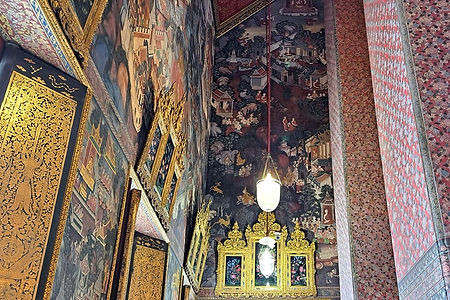
The interior of a Thai Buddhist temple is carefully organized to guide worshippers and monks through a spiritual journey, reflecting both practical function and symbolic meaning. Central to the layout is the main Buddha image, often placed on an elevated pedestal at the far end of the viharn or ubosot, creating a focal point for meditation, prayer, and ritual.
A hallmark of Thai temple interiors is the extensive use of murals, which line the walls and ceilings. These murals depict stories from the Jataka tales (the Buddha’s past lives), Buddhist cosmology, and local legends, combining narrative and decorative artistry. The colors are vivid, often with gold leaf accents, creating a luminous effect that enhances the sense of sacred space. The ceiling may feature painted celestial motifs, mythical creatures, or geometric patterns, emphasizing the temple as a microcosm of the universe and a bridge between the earthly and the divine.
Complementing the murals are statues, icons, and ritual objects that reinforce spiritual teachings and serve protective or devotional functions. Guardian figures may flank entrances, while smaller Buddha statues, votive images, and relic containers fill niches and altars throughout the hall. Sacred symbols, such as lotus motifs, dharmachakras (wheel of Dharma), and mythical animals, are incorporated into woodwork, pedestals, and decorative panels, creating a cohesive visual language of devotion. Together, the layout, murals, and sacred icons transform the temple interior into a living spiritual environment, where worship, meditation, and contemplation are inspired and enhanced through art, architecture and symbolism.

Thai Deities
In many Thai Buddhist temples, certain deities and spiritual figures occupy a special place, reflecting a uniquely Thai blend of Buddhism, local folklore, and guardian powers rooted in nature. This reflects a syncretic belief system that allows temples to serve as both centers religious devotion and spaces where cosmic, natural, and moral forces are acknowledged and harmonized.
Prominent deites seen include Thao Wessuwanis - guardian deity of wealth and protector against evil, often depicted holding a mace and standing near entrances to ward off malevolent spirits. Phra Rahu - a celestial deity associated with eclipses and cosmic influence, is believed to have the power to absorb misfortune, and images of Rahu are frequently displayed in temples and shrines to avert bad luck.
Other figures combine asceticism with spiritual guidance. Phra Ruesi (the hermit sage) represents meditation, wisdom, and longevity, often portrayed in forested postures or with a long beard, and is invoked for health, knowledge, and protection. Nang Kwak - a female spirit of prosperity and fortune, is commonly found at the entrance of shops or temple halls, raising a hand in a beckoning gesture to attract wealth and good business. Phra Mae Thorani - the Earth goddess, holds a central role in Buddhist cosmology in Thailand; she is famously depicted wringing water from her hair to drown Mara’s armies.
Together, these figures illustrate the distinctively Thai integration of Buddhist teachings with local spiritual beliefs, where deities serve both protective and auspicious functions. Their presence in temples through statues, murals, and ritual placement, creates a visual and symbolic reinforcement that connects devotees with the spiritual forces believed to govern both the physical and metaphysical world.

Hindu Deities
In addition to Buddhist figures, many Thai temples incorporate Hindu deities, reflecting the deep historical and cultural influence of Hinduism on Thai art, cosmology, and ritual practices. These deities are often integrated seamlessly into the temple’s spiritual landscape, demonstrating Thailand’s syncretic religious tradition, where Buddhist and Hindu elements coexist.
Among the most prominent is Phra Phrom, the Thai representation of Brahma, the creator god. Often depicted with four faces and four arms, Phra Phrom symbolizes wisdom, creation, and benevolence, and shrines dedicated to him are popular for offering prayers for guidance and good fortune. Phra Indra, the Thai form of Indra (the Hindu king of the gods), is frequently shown riding the three-headed elephant Erawan, embodying authority, rain, and protection against evil forces.
Other deities include Vishnu, the preserver, whose images emphasize protection and cosmic balance, and Shiva, the destroyer and transformer, often depicted in meditative or cosmic dance postures, symbolizing renewal and the cyclical nature of life. Ganesh, the elephant-headed remover of obstacles, is especially revered in Thai temples for blessings of prosperity and success. Through these Hindu figures, Thai temples visually and ritually express a blended spiritual universe, where Buddhist soteriology and Hindu cosmology coexist, guiding devotees in both worldly affairs and spiritual development.