
Thonburi


Royal Barges National Museum
Originally functioning as a royal barge dock and storage facility under the supervision of the Bureau of the Royal Household and the Royal Thai Navy, the site was significantly damaged during the Second World War, after which responsibility for repairing and preserving the royal vessels was transferred to the Fine Arts Department in 1947. Recognising their historical, artistic and ceremonial importance, the department registered the royal barges as national heritage and elevated the dock to the status of a national museum in 1974. The vessels preserve highly specialised traditions of Thai craftsmanship, including elaborate gilding, carved figureheads, decorative glass and the construction of long ceremonial boats designed for royal processions along the waterways. Their continued use in royal ceremonies gives the collection an important element of living heritage, linking historical traditions with contemporary royal ritual. The museum therefore represents not only the preservation of exceptional works of Thai decorative art, but also the continuation of the country's maritime, ceremonial and royal heritage.
Wat Phumarin Ratchapaksi
The temple forms part of the historic religious and riverside landscape of Bangkok Noi and is particularly notable for its traditional mural paintings, which provide evidence of the artistic and religious culture of earlier Bangkok. The Bangkok Metropolitan Administration's cultural division has documented the temple as part of its programme to record and preserve mural paintings in historic temples, with cultural scholars visiting the site to document its artistic heritage. Its location within the network of temples and communities along the Bangkok Noi and Bangkok Yai waterways also places it within a broader historic landscape in which religious institutions, residential settlements and waterways developed together. Research from Chulalongkorn University identifies these canal-side communities as possessing distinctive architectural forms, religious sites, ways of life and cultural practices shaped by their relationship with the waterways. The site's heritage significance therefore extends beyond the temple structure itself, encompassing its murals and its place within the historic cultural landscape of Thonburi.
Wat Arun (Temple of Dawn)
A Buddhist temple has occupied the site since the Ayutthaya period, but its importance expanded considerably following the establishment of Thonburi as the capital under King Taksin and the subsequent development of Bangkok. The temple's monumental central prang was enlarged and transformed through successive royal restorations, with the main prang reaching its completed form in the nineteenth century. Its architecture expresses Buddhist cosmology through the symbolic representation of Mount Meru, while its elaborate decoration incorporates Chinese porcelain and seashells into intricate floral and figurative patterns, demonstrating the skill of Thai craftsmen and the cultural connections created through regional maritime trade. The temple also retains important royal and religious associations, including its former role as a place where the Emerald Buddha was housed before its transfer to the Grand Palace. Extensive conservation undertaken by the Fine Arts Department in the twenty-first century reflects the importance placed on preserving the monument's architectural fabric and decorative details. Its heritage significance consequently rests on the combination of religious continuity, royal history, distinctive architecture, craftsmanship and its enduring place within Bangkok's cultural landscape.
Wat Paknam Bhasicharoen
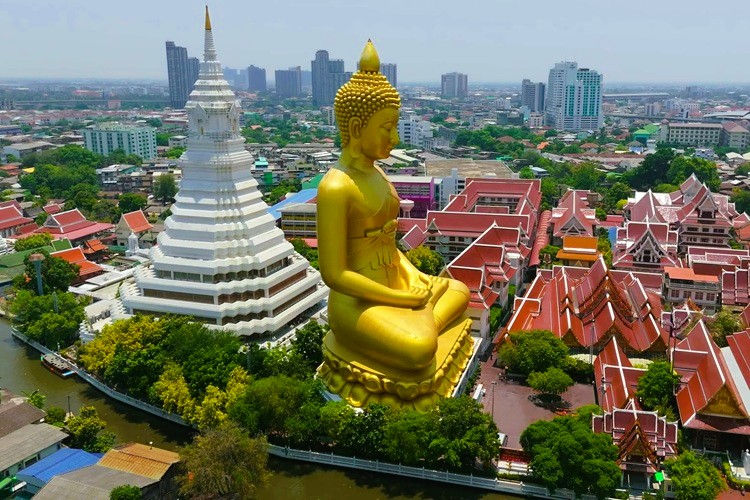
Established as a royal temple and later closely associated with the influential meditation teacher Phra Mongkol Thepmuni (Sod Candasaro), the temple developed into an important centre for Buddhist education, meditation and religious activity in the Thonburi area. The temple's own historical account records the succession of its abbots and particularly emphasises the role of Phra Mongkol Thepmuni and the development of Dhammakaya meditation practice. In the modern period, the construction of the Maharatchamongkhon Chedi has added a major architectural and educational component to the complex, while the temple continues to support religious education, meditation and Buddhist activities. Its heritage importance therefore derives not only from its buildings but from its continuing function as a living Buddhist institution, where religious teaching, monastic traditions, artistic production and community activities remain connected to the history of the temple.
Maharatchamongkhon Chedi Museum
The museum forms part of the modern religious and cultural development of Wat Paknam and is housed within the Maharatchamongkhon Chedi, a monumental structure created as both a religious space and a centre for learning. The chedi incorporates Buddhist imagery, decorative arts and museum displays that present aspects of Buddhist belief, Thai craftsmanship and the history of Wat Paknam. Its significance is closely connected with the temple's wider role in religious education and the preservation of Buddhist traditions, particularly its association with meditation practice and the lineage of important abbots. As a museum within an active monastic complex, it also demonstrates the continuing evolution of Thai religious heritage: historic beliefs and artistic traditions are not simply preserved as static objects but are incorporated into contemporary spaces of worship, education and cultural transmission. The chedi and museum therefore contribute to the heritage value of the wider Wat Paknam complex by linking modern architectural expression with established Buddhist traditions.
Khlong Bang Luang Floating Market
The area is situated within the historic canal landscape of Thonburi, where waterways historically served as routes for transportation, commerce, settlement and community interaction. Research undertaken at Chulalongkorn University identifies Bangkok Yai Canal as a historic waterway with an extensive network of subsidiary canals and distinctive riverside communities comprising temples, houses, architecture, social spaces and cultural activities. The continued presence of community-based markets and activities along Khlong Bang Luang reflects the enduring relationship between everyday life and the waterways of Thonburi. Bangkok Metropolitan Administration documentation likewise records cultural activities and traditional processions conducted along the area's canals, illustrating how waterways have historically functioned as both transportation routes and settings for communal and religious life. Its heritage importance therefore lies less in a single historic structure than in the preservation of a living canal-side cultural landscape, where commerce, community life, architecture and traditional water-based activities remain interconnected.
Bangkok Canal Cruise
Travelling through Bangkok's canals provides access to one of the historical systems that shaped the city's development and identity. Research by Chulalongkorn University shows that, following the establishment of Bangkok as the capital in 1782, the city developed as a predominantly water-based urban environment, with an extensive network of waterways supporting transportation, trade and other aspects of urban life before roads gradually assumed a greater role during the nineteenth century. Canals also influenced the form of riverside settlements, with temples, houses and communities developing in close relationship with the water. In the Thonburi area, Chulalongkorn research has identified particularly strong heritage value in the surviving canal network and its associated riverside communities, architecture, religious sites and traditional activities. A canal cruise therefore provides more than a form of sightseeing: it offers a way of experiencing Bangkok's historic urban landscape from the same waterways that historically connected communities and supported movement, commerce and cultural life.