
Phra Nakhon


National Museum Bangkok
Established as the country's principal national museum in Bangkok, the institution developed from earlier royal collections of antiquities and works of art. The Fine Arts Department traces the origins of Thailand's museum tradition to the reign of King Mongkut (Rama IV), when a museum was established within the Grand Palace, followed by the opening of a public collection during the reign of King Chulalongkorn (Rama V). The collections were subsequently moved to the former Front Palace, or Wang Na, and in 1934 the institution was formally established as the National Museum Bangkok. Much of the museum occupies historic buildings belonging to the former royal complex, including the Phutthaisawan Throne Hall and the Wang Na residential buildings, creating an important relationship between the collections and the architecture in which they are displayed. The Fine Arts Department describes the museum as a central institution responsible for preserving and interpreting archaeological objects, historical artefacts and works of art, while its Wang Na galleries also preserve examples of the distinctive craftsmanship and architecture of the Rattanakosin period. Its heritage importance therefore lies both in the national significance of its collections and in its preservation of an important historic royal landscape.
Royal Grand Palace
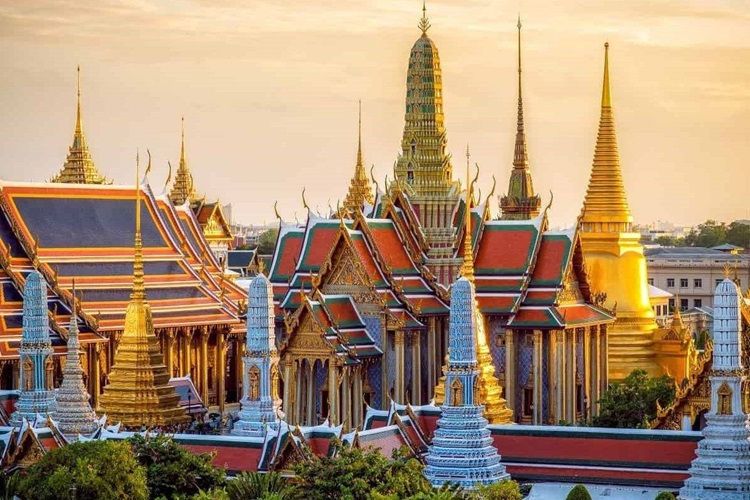
Constructed in 1782 following the establishment of Bangkok as the capital by King Rama I, the complex became the principal royal and administrative centre of the early Rattanakosin kingdom. Its original plan incorporated three principal components—the royal palaces, residential quarters and the temple now known as Wat Phra Kaew—following the traditional relationship between the royal palace and a royal Buddhist temple established in earlier Thai capitals. Successive reigns expanded and altered the complex, particularly during the nineteenth century, when Western architectural influences were incorporated alongside established Thai forms. The resulting buildings demonstrate the development of royal architecture from the early Rattanakosin period through the modern era and include some of the most important ceremonial and architectural spaces associated with the Thai monarchy. Its heritage significance is consequently both architectural and historical, as the complex embodies the foundation and continuing development of Bangkok as the capital while preserving traditions of royal ceremony, Buddhist patronage and Thai court culture.
Wat Phra Kaew (Emerald Buddha)
Established within the royal palace complex at the foundation of Bangkok, the temple was constructed as the royal chapel of the new capital and differs from an ordinary Buddhist monastery in that it has no residential monastic quarter. Its central religious image, the Emerald Buddha, is one of Thailand's most revered Buddha images and was brought to Bangkok during the reign of King Rama I after being taken from Vientiane. The image is dressed ceremonially according to the seasons, with the changing robes forming part of the royal and Buddhist ritual calendar. The temple's architecture and murals also communicate important elements of Thai Buddhist cosmology and the Ramakien, the Thai adaptation of the Ramayana. Together with the surrounding palace buildings, the temple forms an exceptionally important part of the historic core of Rattanakosin, where Buddhist religious traditions and royal authority have been closely connected since the foundation of Bangkok. Its heritage importance therefore rests on its continuing religious function, royal associations, artistic traditions and role as one of the principal sacred sites of Thailand.
Queen Sirikit Museum of Textiles
Established in 2003 at the Queen's initiative within the Ratsadakorn-bhibhat Hall of the Grand Palace, the museum was created as a centre for collecting, studying, preserving and presenting Thai textiles and the history of Thai dress. Its collections document a wide range of traditional textiles and clothing while also preserving garments associated with Queen Sirikit's public and diplomatic role, including royal Thai dress developed and promoted during the twentieth century. Government sources emphasise her role in promoting Thai silk and other indigenous textiles, particularly through the SUPPORT Foundation, which provided opportunities for rural communities to develop sustainable livelihoods while maintaining traditional weaving and handicraft knowledge. The museum therefore has considerable heritage importance as a centre for the preservation of intangible cultural heritage, since textiles embody techniques, designs, knowledge and regional identities transmitted between generations. Its work also demonstrates how traditional Thai craftsmanship has been adapted and presented within contemporary national and international contexts, contributing to the continued recognition of Thai textile heritage.
Wat Pho (Reclining Buddha)
Originally an Ayutthaya-period monastery known as Wat Phodharam, the temple was extensively restored and elevated to royal-monastery status under King Rama I following the establishment of Bangkok. A major second restoration during the reign of King Rama III transformed the complex into an important centre for Buddhist learning, arts and knowledge, with additional halls, gardens, inscriptions and architectural features constructed throughout the temple. The monumental Reclining Buddha, housed in its own vihara, is among the best-known works of Thai Buddhist sculpture, while the wider complex contains extensive murals, sculptures, architectural decoration and the celebrated group of four royal chedis. Particularly significant are the 1,440 stone inscriptions created in the nineteenth century, which record religious and secular subjects and preserve a broad range of Thai knowledge. These inscriptions were subsequently recognised by UNESCO's Memory of the World programme, reinforcing the site's significance as a repository of intellectual as well as religious heritage. The temple consequently represents a rare combination of living Buddhist practice, royal architecture, traditional arts and the deliberate preservation of Thai knowledge.
Bangkok City Pillar Shrine
Established at the foundation of Bangkok in 1782, the shrine embodies the traditional Thai practice of erecting a city pillar when establishing a new capital, with the pillar symbolising the foundation, stability and auspicious future of the city. The original pillar was made from auspicious wood and was installed during the reign of King Rama I as part of the ceremonies accompanying the establishment of Rattanakosin. During the reign of King Rama IV, a second pillar was created to replace the deteriorating original, while the shrine itself was rebuilt in a more substantial architectural form incorporating a Thai-style prang. The site subsequently became associated not only with the city pillar but with several protective deities traditionally believed to safeguard the capital. Government cultural sources explain that the shrine continues to function as an important place of worship and as a symbolic centre of confidence, stability and civic identity. Its heritage significance therefore extends beyond its physical architecture: it preserves a ceremonial tradition associated with the founding of Bangkok and illustrates the interaction of Buddhist, Brahmanical and indigenous beliefs within Thai urban culture.
Sala Chalermkrung Royal Theatre (Khon Show)
Opened as a major royal theatre in the early twentieth century, the venue has undergone a transformation from a prestigious cinema and entertainment centre into an institution strongly associated with the preservation and presentation of Thai performing arts. Its current Khon performances, introduced in 2005, are based on the Ramakien and combine traditional masked dance-drama, classical Thai music, elaborate costumes and highly codified movement with modern stage technology. The theatre's own historical records emphasise the role of these performances in maintaining Thai high-level classical dance and making the art form accessible to both Thai and international audiences. The performers are trained under specialists associated with the College of Dramatic Arts and the Fine Arts Department, while the theatre also maintains traditional teacher-honouring and initiation ceremonies for Khon and theatrical practitioners. Its heritage importance therefore lies in the relationship between a historic performance venue and the continuing practice of Khon, demonstrating how a traditional performing art can be preserved, taught and adapted for contemporary audiences while retaining its established artistic conventions.